
How Does Preschool Improve Social Skills in Children?
Social skills do not develop overnight. An Islamic preschool Vancouver center creates a structured environment where children learn socialization through everyday routines.
So, how exactly does preschool help children become more social and confident? Let’s take a closer look.
Why Social Skills Are Important For Children?
Most parents stress reading and numbers. But social skills are the silent backbone of all the rest. Here’s why it’s important:
Children who can share and take turns make friends more quickly and keep them longer.
Children who can regulate their emotions in a group setting perform better academically by grade 3.
Kids with good communication skills ask for help instead of acting out, reducing behavioral issues in school.
Social confidence in early years shields children from anxiety and peer pressure as they mature.
A good listener who can read the social cues can adapt to new environments without falling apart.
Preschool intervention is far more effective than corrective social skills training at older ages in terms of early intervention.
What Social Skills Do Children Learn in an Islamic Preschool Vancouver Facility?
Preschool is the first real experience children have of a structured social environment outside of the home. There, they develop core competencies that influence their relationships with others for years to come.
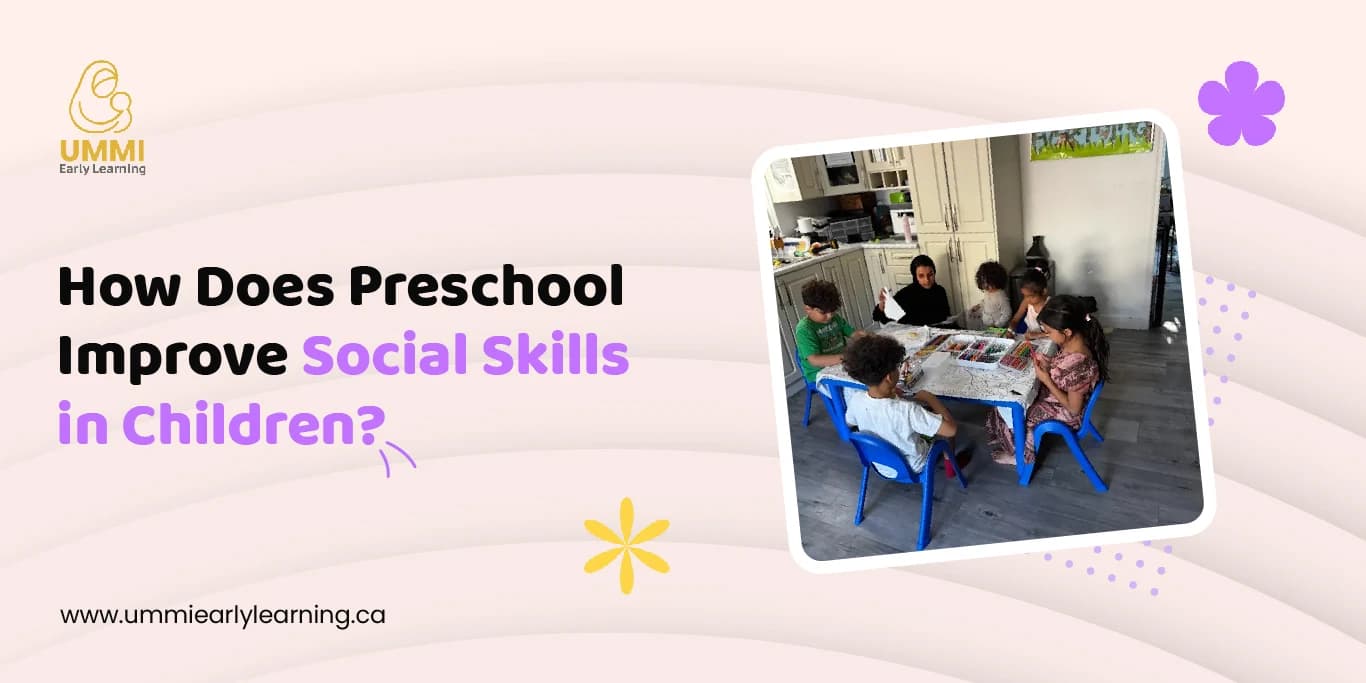
Taking Turns: Children learn to wait their turn during group activities and games. This builds patience and teaches them that others have equal rights to time and space.
Sharing Resources: Sharing becomes a daily practice, be it the art supplies or toys. Children learn that sharing will lead to better gains than taking.
Listening to Others: Group circle time teaches children to be quiet when someone else is speaking. This is the basis of respectful communication.
Solving Small Conflicts: Disagreements are a part of life, even in preschool. Children learn to solve problems with words, not reactions.
Reading Social Cues: Hanging out with peers throughout the day helps children learn to read facial expressions and body language. They start feeling how others feel without being told.
Follow the Rules of the Group: Classroom routines help children learn that rules apply to everyone. This fosters a sense of fairness and community responsibility.
At UMMI Early Learning Academy, we reinforce these values through the values of respect, kindness, and empathy that are rooted in Islamic early childhood education.
How An Islamic Preschool Vancouver Facility Teaches Kids to Share and Cooperate?
Preschool places children in structured group settings to teach the value of sharing and cooperation. The daily interactions in a daycare environment eventually develop the social habits needed for a kindergarten environment.
This process has more significance in a Muslim preschool Vancouver facility. Teachers associate sharing with Islamic values such as generosity and brotherhood, providing children with a moral as well as a social reason to cooperate. Check out how they nurture these qualities among kids:
Group Play Activities
Children share toys, art materials, and play spaces. Turns become a natural expectation, not an occasional rule.
Collaborative Projects
Helping to build a block tower or solve a puzzle shows children that working together yields better results.
Guided Conflict Resolution
When children disagree, teachers guide children through talking it out. It creates the habit of using words rather than reacting.
Circle Time Discussions
Group talking teaches children to listen to others talk and to wait for their turn to talk.
Role Modeling
Teachers model cooperative language, such as “Can I help?” or “Let’s do this together,” providing children with scripts they can use.
There are many studies on preschool’s long-term social benefits. Take the case of the Perry Preschool Project. It’s a landmark study that followed participants into adulthood and found that early childhood education had long-term behavioral benefits, including reduced aggression and increased social competence, compared with children who did not attend preschool.
Why Preschool Is the Prime Time to Build Emotional Intelligence For Social Skills?
The window between 2 and 6 years old is the most powerful time for emotional intelligence development. The brain is developing faster than at any other time in life. The neural pathways for empathy, self-regulation, and emotional recognition are being built right now. What kids go through at this age gets hardwired in.
In an Islamic preschool Vancouver, structured play and peer interaction opportunities are offered so that children can daily practice reading emotions in others. Have a look at its benefits:
Self-awareness
Children learn to identify their feelings, the first step toward managing them. A child who can say, “I’m frustrated,” is already regulating better than one who can’t.
Empathy Development
Children naturally notice a friend crying or feeling left out in group situations. Guided teachers convert these into learning opportunities.
Impulse Control
When children have to wait their turn, share materials, or resolve minor disputes, they are training their prefrontal cortex to pause and think before acting.
Vocabulary for Emotions
In Islamic daycare Vancouver programs, children learn to connect awareness of emotions to values such as compassion and patience, giving them a richer vocabulary for understanding feelings.
How Structured Play in Preschool Develops Communication Skills?
Structured play activities in a full-time daycare Vancouver facility give kids a real reason to talk. If a child wants to take a turn on the slide or wants to get into a game, they have to use words to make it happen. That pressure, in a safe, supported environment, is exactly what builds communication skills quickly.
Children learn to wait, listen, and respond. It echoes the give-and-take rhythm of actual dialogue.
Children have to be able to make themselves clear enough for others to understand their ideas.
Kids negotiate roles, invent rules, and describe imaginary situations, increasing vocabulary.
Answering questions in front of peers builds confidence and verbal clarity.
Frequently Asked Questions (FAQs)
How does an Islamic preschool Vancouver center resolve conflicts among children?
Teachers coach kids to talk it out. It’s about cultivating the habit of using words, and in an Islamic setting, that process is tied to values like patience and respect.
What is the average time for a child to learn social skills in preschool?
No fixed time period. Daily exposure to group routines gives visible progress in the first few months of enrollment.
Does structured play really help young children communicate?
Yes. When a child wants something from a peer, they must use words. That real-world pressure builds vocabulary and confidence quickly.
How is social development different at a Muslim preschool Vancouver center?
Social behaviors like sharing and cooperation are tied to Islamic values such as generosity and brotherhood, helping the behavior become more consistent and meaningful.
Conclusion
Social skills are practiced, modeled, and reinforced in thousands of small moments every day. Preschool sets the stage for those moments to occur regularly and purposefully.
UMMI Early Learning Center is a values-based Islamic preschool Vancouver families trust, where social development takes place in the spirit of Islamic early childhood education. Enroll your kid now!