
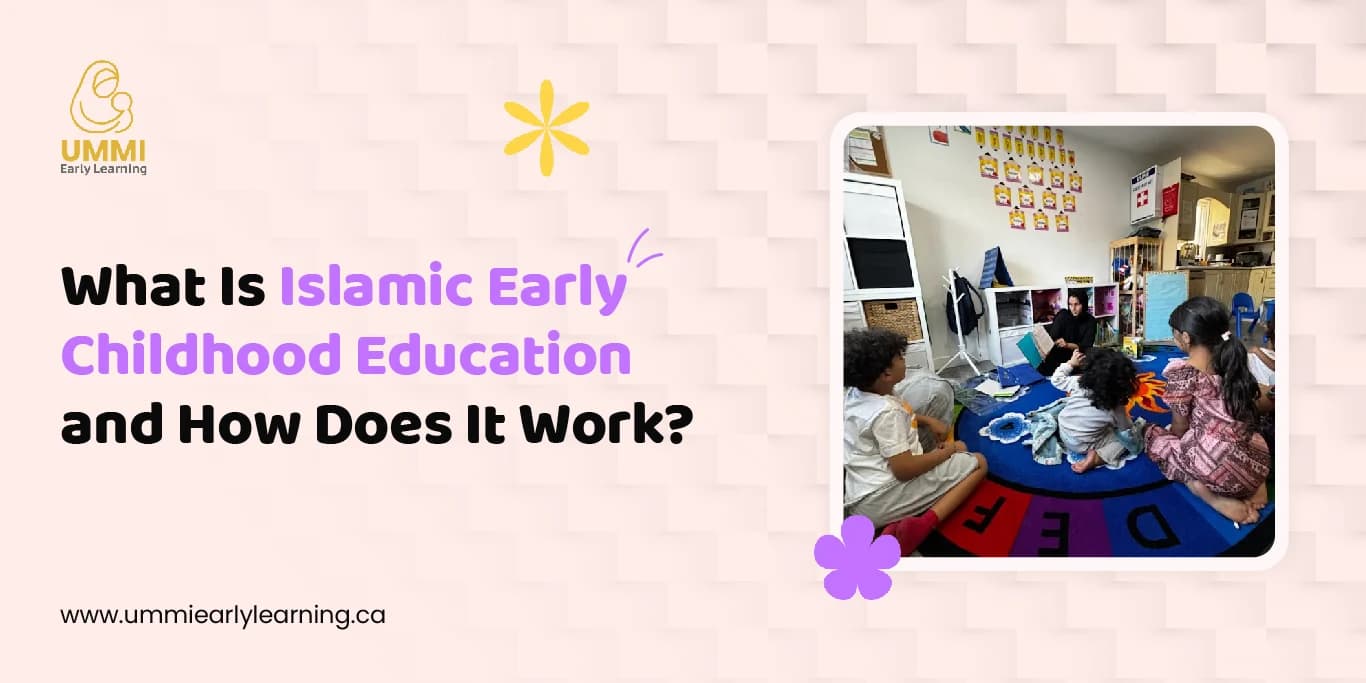
What Is Islamic Early Childhood Education and How Does It Work?
Islamic early childhood education is a systematic approach to early learning in which Islamic values, Arabic language, and Quranic principles are incorporated into a child’s development from birth to age six. This is not a substitute for typical early childhood programming.
It complements formal early childhood education, offering the same play-based learning, social development, and cognitive milestones you would expect from any licensed early learning program, but in a faith-centered environment.
In this blog, we will be explaining what Islamic early learning is and how it works.
What is Islamic Early Childhood Education?
Islamic early childhood education is a structured early learning approach that incorporates Islamic values for children, generally from birth to 6 years of age, while the brain is most receptive to language, habit, and identity formation.
The entire learning environment, from the daily schedule to the way teachers communicate with children, is based on Islamic principles. And that difference is very important, because it helps kids absorb culture, tone, and belonging.
What Makes Islamic Early Learning Special?
Check out what makes Islamic daycare Vancouver centers unique:
1. Faith is Built Into the Fabric
Kids learn to:
Say Bismillah before meals
Make dua before activities
Listen to the recitation of the Quran
All these become part of their normal day.
2. Halal Childcare BC Standards Apply
Food in these centers must be halal, and the environment must be consistent with Islamic ethics in how children are treated, disciplined, and spoken to.
3. Identity Development Begins Early
Children who see their faith reflected in their learning space develop a stronger and more grounded sense of who they are before the outside pressures of later schooling begin to take their toll.
4. Staff are qualified in both ECE and Islamic practice
At a licensed Islamic daycare Vancouver, staff have recognized early childhood education credentials and an understanding of Islamic values. So, they exhibit both professional care and faith at the same time.
How Islamic Early Childhood Education Builds a Child's Faith and Character?
Islamic early childhood education integrates religious values, moral behavior, and Islamic practices into daily life from the beginning of a child’s life, affecting the child’s faith and personality. It is no longer a subject in itself, but the way a child sees himself, others, and the world around him.
Here’s how faith is built into daily learning:
Daily Repetition of Quranic Language
Children hear and practice short surahs, duas, and dhikr. The repetition at this age creates deep memory pathways.
Akhlaq as Modeled By Teachers
In Islamic early learning, teachers model akhlaq (good character) in their speech, conflict resolution, and kindness. Children take in the behavior much more than the instruction at this age.
Makes Worship A Daily Activity
Little things like saying Bismillah before eating, and making dua before bed, help to make worship feel like a normal part of life.
Stories of the Prophets as Moral Anchors
Narrative, honesty, patience, and gratitude are taught through age-appropriate stories from the Islamic tradition. Children respond emotionally to stories in a way they cannot to abstract rules.
Community And Sense of Belonging
Being with other Muslim children helps to affirm identity. When a child sees their values reflected in the world around them, they grow up secure in their identity.
Tactile and Sensory Play with Islamic Themes
Activities like making crescent moons, learning about Ramadan through play, or role-playing Eid preparations bring abstract concepts to life. Children learn by making, touching, and doing.
Islamic values as positive reinforcement
Teachers praise children with ‘MashaAllah’, ‘JazakAllah Khair’. This encourages good behavior, and at the same time, it teaches the child the language and manners of faith.
What are the Core Principles of the Islamic Early Childhood Education Curriculum?
The Islamic early childhood education curriculum is premised on the notion that the spiritual, moral, and intellectual development of a child is not separable from the others. They grow together from the very beginning.
Let’s have a look at the principles that guide this Islamic early learning environment:
Tawheed as the Foundation
The concept of Tawheed, the oneness of Allah, sits at the center of everything. Children are encouraged to observe:
Nature
Their relationships
Their own abilities as indications of one Creator
Character Before Academics
Islamic early childhood education prioritizes akhlaq before academic achievement. Kids practice honesty, kindness, patience, and gratitude every day.
Arabic and Quranic Exposure
Introducing children to the recitation of the Quran and the fundamentals of the Arabic language from a young age creates a lasting bond with the faith. At this age, the brain is naturally soaking in language patterns. If you start early, the sounds and rhythms and meanings of the Quran become familiar and comforting.
Play as Learning Tool
Play is also structured to be a part of the learning process. Children are invited to experience Islamic values through storytelling, art, movement, and imaginative play.
Family and Community Connection
Parents are viewed as partners in the learning process in the curriculum. Islamic daycare Vancouver programs promote families to reinforce values at home. When home and school teach the same values, the lessons last forever.
Daily Activities of Islamic Early Childhood Education Programs
Islamic early childhood education programs organize daily learning around a rhythm of faith, play, and core academics. The day is structured in such a way that Islamic practices are organic.
Here’s what a day in faith-based early learning Vancouver center like UMMI Early Learning Academy looks like:
The day begins with a greeting and a short dua.
Short surahs are introduced through stories and songs. The first goal is familiarity and love of the Qur’an.
Math activities are thematically anchored in Islamic patterns and natures.
Play times are also allocated. Most activities are related to Islamic values. Learning is child-initiated, experiential, and within a guided setting.
At mealtime, sunnah etiquette, like sharing, hand washing, saying Bismillah, eating with the right hand, and showing thanks, is encouraged.
The afternoon wind-down often includes Islamic stories or quiet creative time.
Frequently Asked Questions (FAQs)
What is the best age for Islamic early childhood education?
The earlier the better. Programs are meant for children up to the age of five. This is the time when the brain absorbs language, habits, and values most quickly.
Is Islamic early childhood education only for religious families?
It is for Muslim families who want faith to be included in the daily learning. But the advantages of academic and character-building standards are for any child who thrives in a values-based environment.
Is prior knowledge of Arabic required to join?
No prior knowledge of Arabic is needed. The programs introduce Arabic sounds, short surahs, and duas in a gradual way, through play and repetition. Kids pick it up through regular exposure.
Are these programs licensed and regulated?
Yes. Quality Islamic early learning centers are fully licensed and meet government standards for health, safety, and educator qualifications in addition to their faith-based curriculum.
How can I tell if an Islamic early learning program is genuine?
You can ask some questions. How do meals, transitions, and conflict resolution become faith-building sites? What kind of training have the teachers received? A real program always gives clear and confident answers.
Conclusion
Islamic early childhood education is not a separate system parallel to regular learning. It is learning, but with a strong moral foundation built in from the very beginning. Faith permeates how they are welcomed, how conflicts are resolved, the stories they hear, and how their curiosity is addressed each and every day.
At UMMI Early Learning Center, faith is the core of our daily activities. If you are looking for a licensed Islamic daycare Vancouver center that is serious about child development, contact us now!